
Middlesex County Court Records After a Jail Arrest
An arrest in a Middlesex County town does not create a court record on its own. The arrest starts a chain. Police book the person, the case heads to a Middletown courtroom for arraignment, and a state prosecutor decides what charges to bring. At that point a court case opens. That case is the record the public can read. It holds the formal charges, the docket number, the court location, and each hearing date. Arrest charges can change after the prosecutor reviews the file, so the booking charge and the filed charge are not always the same.
Connecticut runs two separate tracks, and they answer different questions. The custody track is the Connecticut Department of Correction. It tells you whether a person is held, where, and under what status. The court track is the Judicial Branch. It holds the charges and the case history. For the custody side and booking detail, see the jail inmate records page; for booking photographs, see the jail roster mugshots page. The court records that follow an arrest are a separate matter from custody. Keep the two systems straight. A person can be out of custody while a court case is still open, and a court case can close while another hold keeps someone confined.
The Middlesex Judicial District and GA 9
Middlesex County criminal cases run through two court tracks at 1 Court Street in Middletown. The Middlesex Judicial District, often called Part A, handles the more serious matters. The Division of Criminal Justice says Part A mostly takes Class A and Class B felonies from every community in the district. Geographical Area No. 9, called Part B, handles the rest. Part B primarily takes Class C, D, and E felonies, plus misdemeanors, infractions, and motor vehicle offenses. A Geographical Area court, or GA court, is Connecticut's lower criminal and motor vehicle court. The split is set by how serious the offense is, not by which town it came from.
The prosecutor for the district is the State's Attorney, not an elected county district attorney. Connecticut uses State's Attorneys across its judicial districts. The Middlesex State's Attorney is Michael A. Gailor, appointed by the Criminal Justice Commission on July 25, 2018. He serves as the chief law enforcement officer in the district. Jason Germain is listed as the Supervisory Assistant State's Attorney. The office covers fifteen towns: Chester, Clinton, Cromwell, Deep River, Durham, East Haddam, East Hampton, Essex, Haddam, Killingworth, Middlefield, Middletown, Old Saybrook, Portland, and Westbrook. A case from any of these towns lands in Middletown, in Part A or Part B by charge level.
The official prosecutor page lays out these roles and the towns covered. You can read it at the Middlesex State's Attorney page on the state portal.
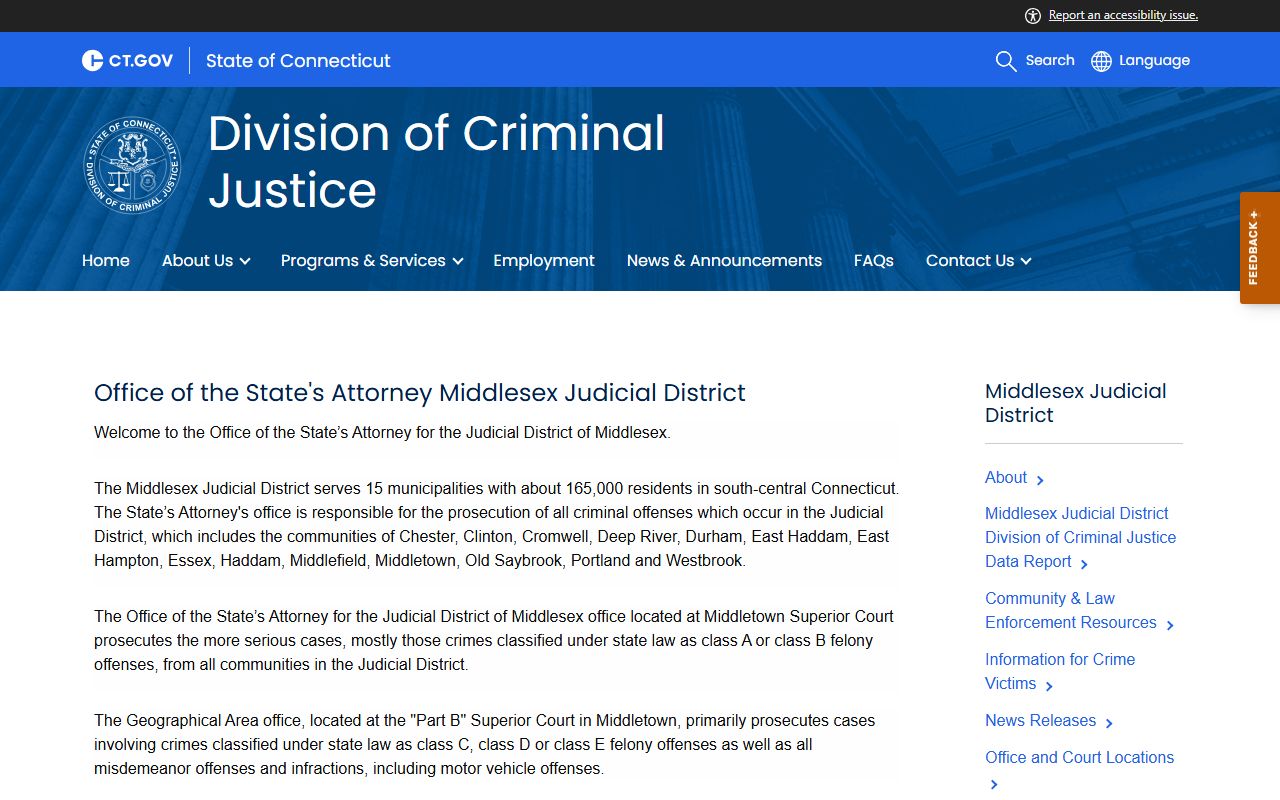
That page confirms who files Middlesex County charges and which courts handle which offense levels. It is the source for the Part A and Part B split and the appointment date.
The Judicial Branch Case Look-up for Middlesex County Records
Once charges are filed, the records show up in the Connecticut Judicial Branch case lookup. This is the court track, separate from any custody search. The index pulls together several tools in one place. You can search pending cases by defendant or by docket number. You can search convictions by defendant or docket. You can pull a daily docket by court or by defendant. There is also an attorney and firm search by juris number. Each tool feeds off the same court data but answers a different question about a case.
The lookup is helpful, but it comes with real limits the Judicial Branch states plainly. The online case lookup is a public service. It is not the official court record, and it is not a substitute for a criminal background check. To confirm anything, check the official court information filed at the court of record. Conviction information generally appears for no more than ten years after sentencing, unless Practice Book Sec. 7-13 sets a shorter display period. The data can also shift because of erasures, corrections, pardons, and other changes. Youthful offender, juvenile, infraction, and violation convictions are not shown at all.
You can reach every tool from the Judicial Branch case look-up index. It is the front door for Middlesex County court records after an arrest.
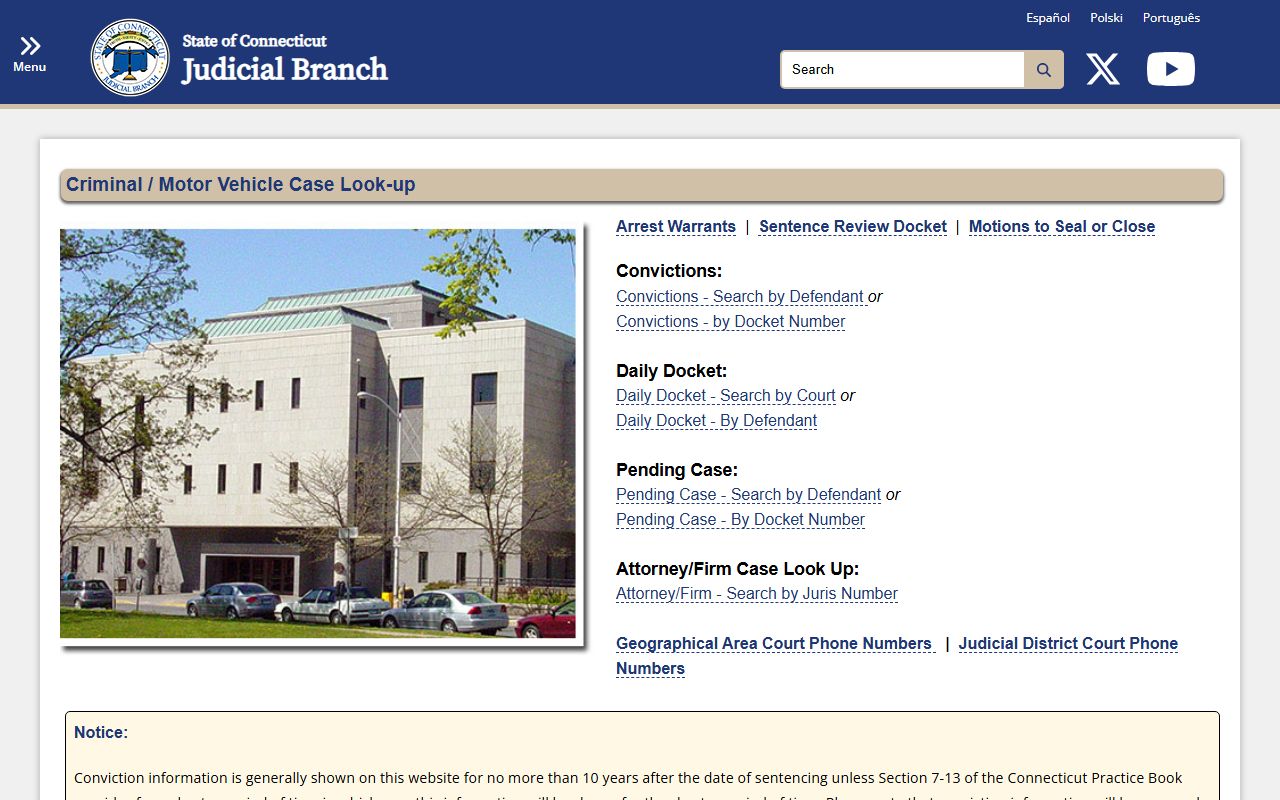
The index page links each search type, so a reader can move from a pending case to a conviction check or a daily docket without hunting for separate URLs.
Search Middlesex County Court Records by Defendant
The most common way to find a Middlesex County case is the pending case search by defendant. It works from a name, so you do not need a docket number. The system runs a begins-with match on the last name, which helps when you are not sure of the full spelling. You can narrow the results with a first initial, a birth year, and a court location. Pick Middlesex Judicial District for Part A matters or Middletown Geographical Area 9 for Part B matters.
- Open the pending case search by defendant on the Judicial Branch site.
- Type the last name in the begins-with field, which is required.
- Add a first initial and a birth year to cut down on matches.
- Choose Middlesex Judicial District or Middletown Geographical Area 9 in the court dropdown, then run the search and open the case to read the charges and status.
The field table below shows what the form asks for and which entries are required. A blank case-type field returns all types, while choosing Criminal or Motor Vehicle limits the results.
| Field Label | Type | Required | Notes |
|---|---|---|---|
| Last Name (begins with) | Text | Yes | Up to 60 characters; begins-with match. |
| First Initial | Text | No | One character to narrow results. |
| Birth Year | Text | No | Four digits. |
| Birth Year Range | Text | No | One character to widen the year span. |
| Court Location | Dropdown | No | Includes Middlesex Judicial District and Middletown Geographical Area 9. |
| Case Type | Dropdown | No | Blank, Criminal, Motor Vehicle, or MV license/registration suspension. |
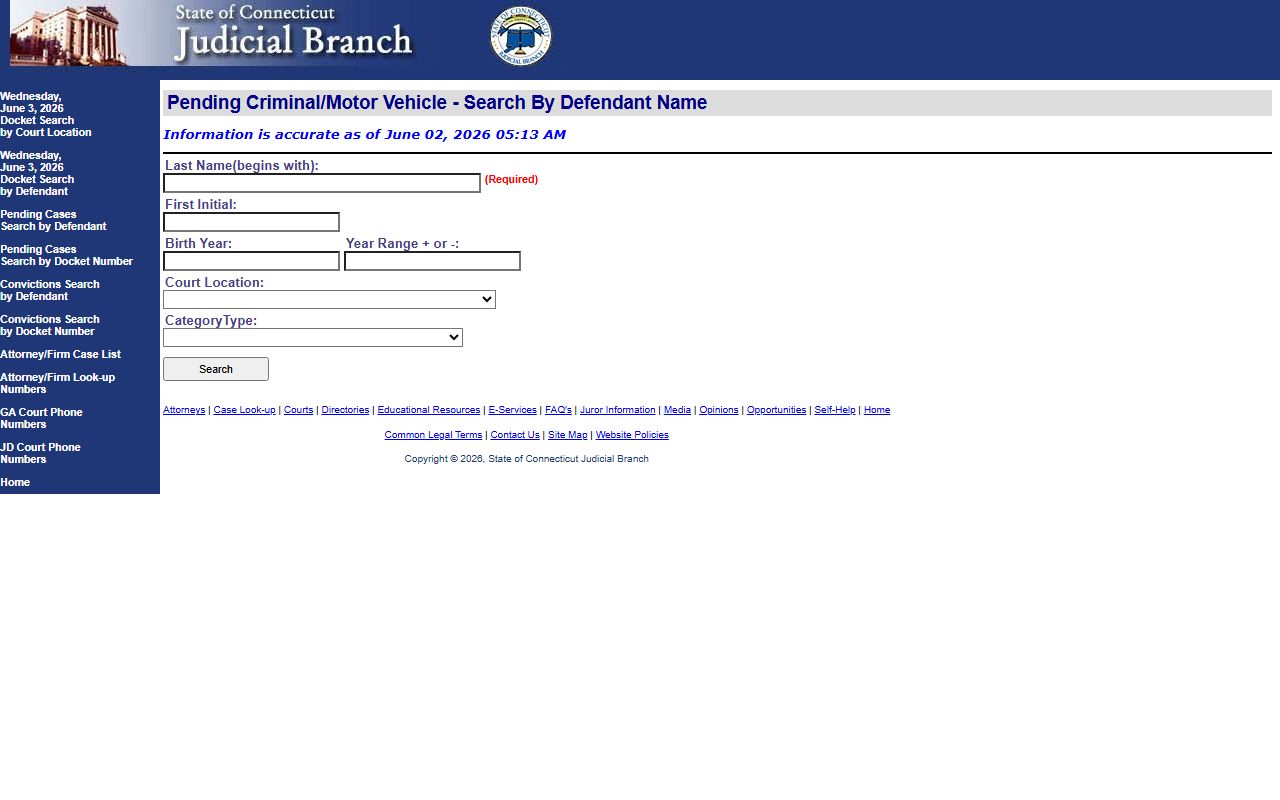
The pending search shows open cases only, so a closed or disposed matter will not appear here even if the arrest was recent. You can find the form through the pending case search by defendant tool.
Search Middlesex County Court Records by Docket Number
If you already have a docket number, a direct docket search is faster and more exact. A docket number is the case number a court assigns when the file opens. It comes in parts: a court code, a case type, a two-digit year, a docket number, and a suffix. For Middlesex County, the court codes that matter are MMX for the Middlesex Judicial District and M09M for Middletown Geographical Area 9. The case type is usually CR for criminal or MV for motor vehicle.
Every field in this search is required, so you need the full docket string to get a clean result. The table breaks down each piece.
| Field Label | Type | Required | Notes |
|---|---|---|---|
| Court Code | Dropdown | Yes | MMX for Middlesex JD; M09M for Middletown GA 9. |
| Case Type | Dropdown | Yes | CR, MV, CI, or MI. |
| Year | Text | Yes | Two digits. |
| Docket Number | Text | Yes | Up to seven digits. |
| Suffix | Dropdown | Yes | S, T, A, or 0 through 9. |
A docket search returns the one case that matches the code you enter. The docket lookup is linked from the same Judicial Branch index that holds the defendant search.
Daily Dockets for Middlesex County Court Records
Daily dockets are useful when you want to know who is on the court calendar today. Connecticut offers two daily docket searches. One runs by court location, where you pick a court such as Middletown Geographical Area 9 and pull the full list for that date. The other runs by defendant, where a last name in the begins-with field finds a person on the calendar. The begins-with last name is required for the defendant version, the same as the pending search.
There is one caveat worth knowing. The daily docket screens cover the scheduled dockets for that date, but they do not include add-on dockets. A case added to the calendar at the last minute may not show, so a missing name does not always mean a person is not in court that day. The by-court search is reached through the daily docket by court tool.
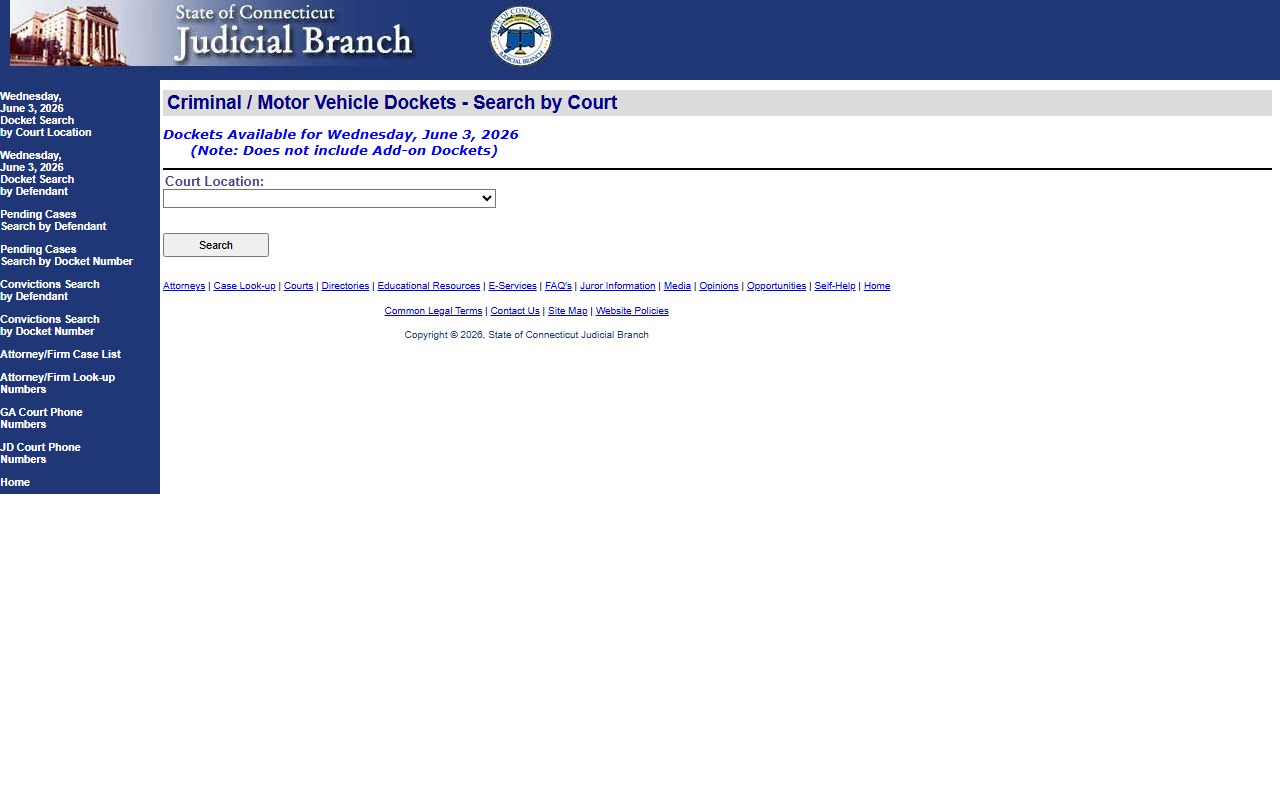
The daily docket is a quick way to confirm a same-day appearance, but the pending case search remains the better tool for the full court record of a charge.
Note: A same-day court appearance can still exist on an add-on docket even when the normal daily docket screen does not list it.
How to Find Court Records of the Charges After an Arrest
Finding the charges that follow a Middlesex County arrest takes a few steps in order. The custody search and the court search answer different things, so use both. Start with custody to confirm where a person is, then move to the court lookups for the actual charges and dates. Older history and certified records have their own routes at the end of the chain.
- Use the DOC locator for custody and location, but do not treat it as the full court case.
- Search pending case by defendant using the last name; add a first initial and birth year, then select Middlesex Judicial District or Middletown GA 9.
- If you have a docket number, search by docket with court code MMX or M09M and the CR or MV case type.
- Check the daily docket by court for same-day appearances, and remember add-on dockets may not be listed.
- For older outcomes, use the conviction search by defendant or docket, keeping the ten-year display limit in mind.
- For a certified criminal history, request it from the State Police Bureau of Identification, since DOC custody alone does not confirm a conviction.
This order keeps the custody record and the court record from getting mixed up. The booking charge that police list at intake can differ from the charge the prosecutor finally files in court.
Bond and Release After a Middlesex County Arrest
Connecticut sets release conditions through the arrest and court process, not through a county jail roster. The arresting agency can release some people on a promise to appear. When a person is presented in court, a judge sets the conditions. For Middlesex County matters, that happens at the Middlesex Judicial District or Middletown Geographical Area 9. If the court orders custody, the person is remanded to DOC, and the custody status may read accused or unsentenced while the case stays open.
One key difference sets Connecticut apart from many other states. DOC does not publish a bond amount as a standard public field in its inmate database. The public DOC record lists status, offense, detainer, and release or sentence dates, but not a per-charge bond figure. To confirm a bond, check the Judicial Branch pending case lookup, the clerk, defense counsel, or the facility. The table below outlines the common release terms in plain language.
| Bond or Release Type | How It Works |
|---|---|
| Promise to Appear | Nonfinancial release with a court date and conditions; verify through court or police records. |
| Cash or Surety Bond | A financial condition tied to the case; confirm the amount with the court or facility. |
| No-Bond or Remand | The court has ordered continued custody; DOC status may show accused or unsentenced. |
| Detainer or Hold | Another agency or matter may block release even when the local bond is resolved. |
| Sentenced Custody | After sentencing, release dates come from DOC sentence calculations, not pretrial bond. |
A detainer is a notice or hold from another agency that can affect release. A no-bond hold means payment will not free the person. Note: A current incarceration is not proof of conviction, since Connecticut also holds accused people who are still awaiting trial.
Warrants That Lead to a Middlesex County Arrest
Many arrests start with a warrant. Connecticut has no county sheriff warrant list, because there is no county sheriff jail operator. The statewide public tool is the Judicial Branch active warrant search, titled for arrest warrants for violation of probation or failure to appear, and orders to incarcerate. It runs from a last name, with at least the first two letters required. You can narrow it by town, court location, first name, or birth year. Middlesex-area towns in the list include Chester, Clinton, Cromwell, Deep River, Durham, East Haddam, East Hampton, Essex, Haddam, Killingworth, Middlefield, Middletown, Old Saybrook, Portland, and Westbrook.
The portal carries a clear warning. It may not contain every active warrant, the data is for information only, and no one should act on it directly. A warrant will not appear if posting it could endanger safety or if it came from a youthful offender proceeding. Several warrant types can lead to a booking. The field table for the search appears below.
| Field Label | Type | Required | Notes |
|---|---|---|---|
| Last Name | Text | Yes | At least the first two letters; begins-with match. |
| Town | Dropdown | No | Statewide list including Middlesex-area towns. |
| Court Location | Dropdown | No | Includes Middlesex Judicial District and Middletown GA 9. |
| First Name (begins with) | Text | No | Optional narrowing field. |
| Birth Year | Text | No | Four digits, example 1900. |
The main warrant types are worth knowing before a search. The list below sorts them by what each one does.
- Arrest warrant: a court-authorized arrest based on probable cause.
- Bench warrant: issued by a court, often for failure to appear or a violation of a court order.
- Violation warrant: tied to probation, parole, or supervision.
- Search warrant: authorizes a search, not always an arrest.
- Fugitive warrant or hold: can involve out-of-state or federal process.
Warrant volume in Middlesex County is steady. The Middlesex prosecutor's 2024 data report says the office reviewed 965 arrest-warrant applications, 106 search-warrant applications, and 1,071 total warrant applications that year. Across 2021 to 2024, the top submitting agencies were the Middletown Police Department with 1,357, the State Police with 624, Adult Probation with 603, the Cromwell Police Department with 401, the Old Saybrook Police Department with 363, and the Clinton Police Department with 310. You can run a name through the Judicial Branch active warrant search for current postings.
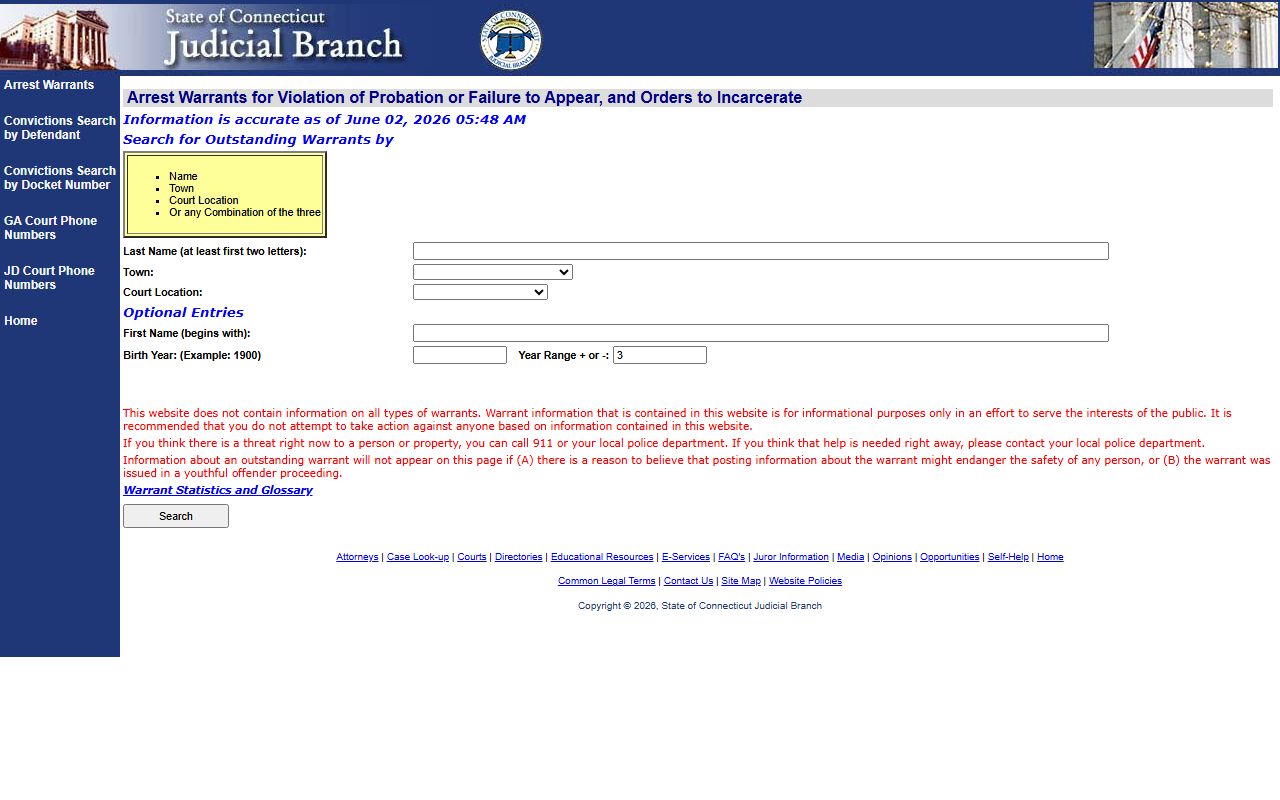
A warrant hit on this tool can explain why a person was booked, but the full charge record still lives in the pending case lookup once the case opens.
Charges vs. Convictions and Record Erasure
Being arrested and charged is not the same as being convicted. A charge is an accusation. A conviction is the result of a plea or a verdict. The two sit at different stages of a case and carry very different weight. The court record may show a charge for months before any outcome, so reading a pending charge as guilt is a mistake. The comparison below lines up the two side by side.
| Charge | Conviction | |
|---|---|---|
| Stage | Accusation | Plea or verdict |
| Burden of Proof | Probable cause | Beyond a reasonable doubt |
| Court Status | Pending or amended | Final disposition |
| May Be Erased | After a dismissal or nolle | Through pardon or statute |
Connecticut does not use the generic sealed-versus-expunged framing. It uses erasure, set out in CGS Sec. 54-142a. When a record is erased, the law restricts its public dissemination, so an erased record cannot be handed out the way an open one can. The conviction search reflects this. Conviction data generally drops off after ten years, and youthful offender, juvenile, infraction, and violation convictions never show. You can read the erasure statute at CGS Sec. 54-142a.
When you need a formal criminal history rather than an online docket screen, the certified route runs through the State Police Bureau of Identification. Requests go by mail, not email or fax, to DESPP-SPBI, 1111 Country Club Road, Middletown, CT 06457-2389. Form DPS-0846-C handles the request. The fees on that form are 36 dollars for a Connecticut name and date-of-birth existence search and 75 dollars for a Connecticut conviction history by name and date of birth. The State Police Bureau of Identification page explains the process.
Restricted Records and FCRA Limits
Some court records after an arrest are not open to the public. Youthful offender cases are confidential and stay out of the public database and the conviction search. Juvenile matters are restricted as well. Erased records under CGS Sec. 54-142a cannot be publicly disseminated. The arrest-record statute, CGS Sec. 1-215, makes a record of arrest public from the time of arrest, but it carries sealing and safety, witness, and victim exceptions that can limit what is released. When a record is held back, it is usually one of these limits at work.
Important: Middlesex County Inmate Population is not a consumer reporting agency under the FCRA, and nothing here may be used for employment, tenant, credit, or insurance screening.